Dots and Boxes Chain Control: Chains, Loops and Move Order
Learn Dots and Boxes chain control by comparing legal first edges on a solver-verified endgame, then trace who must open the next component.
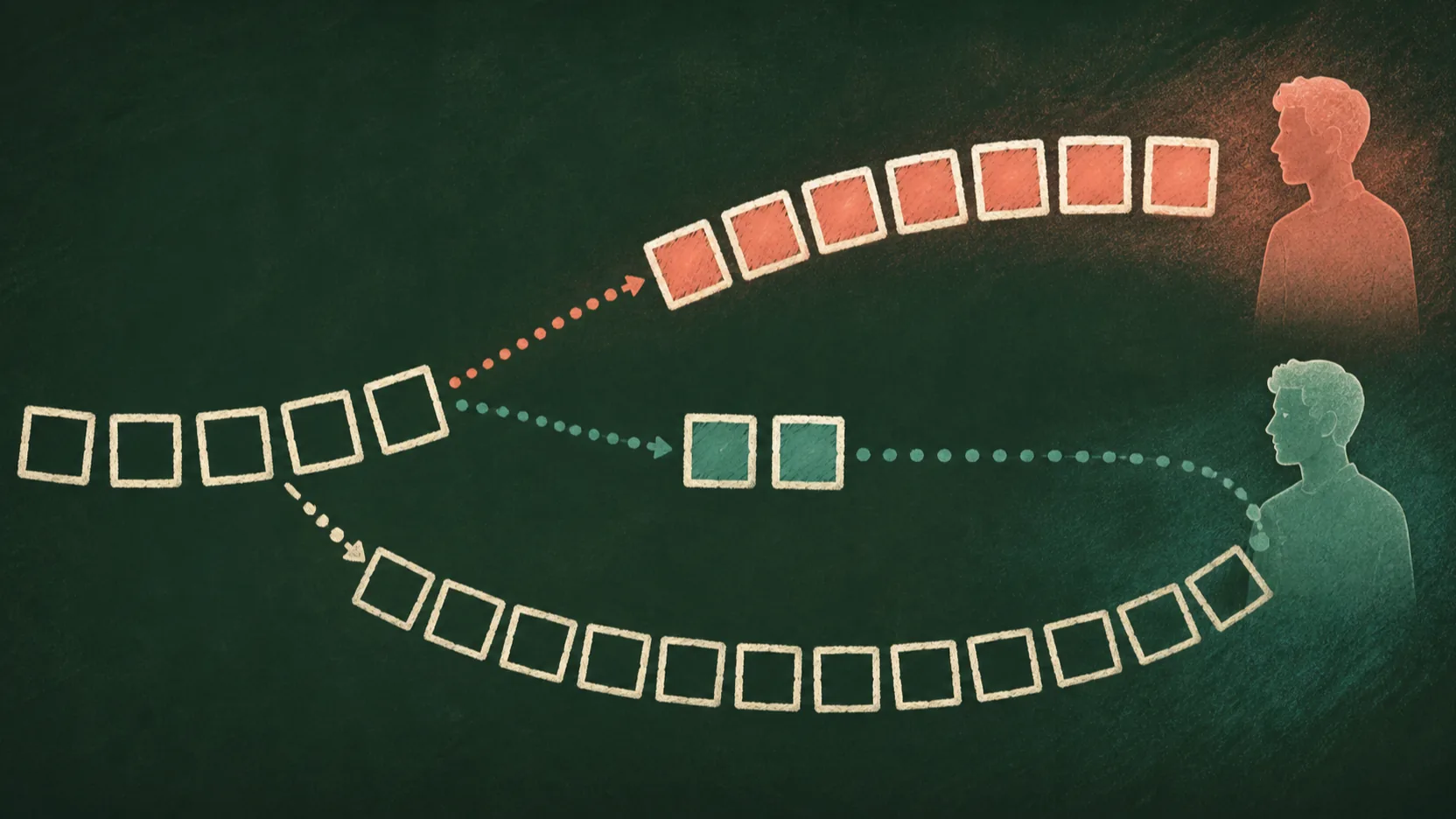
Quick answer
Chain control is about the move after the scoring run. Taking every available box can force you to open the next long chain; a small handout can make your opponent open it instead. Count the complete remaining position, not just the boxes available now.
Why the immediate score can mislead
Closing the fourth side of a box scores one point and gives the same player another turn. That extra turn is valuable while boxes remain available, but awkward when the only legal move opens the next component for your opponent.
The player forced to open a component is the opener. The player who responds and starts collecting it is the controller. The controller may take everything and surrender control, or accept fewer boxes now to influence who opens what follows. Neither choice is automatically correct.
Chains, loops and the handout
A long chain is a connected path of at least three boxes. Once an end becomes capturable, each completed box can lead to the next. A loop has no open end, so its usual control calculation differs.
In the standard chains-and-loops endgame, keeping control of a long chain normally means leaving two boxes; a loop handout normally leaves four. These are counting tools, not universal winning rules. Short components, safe edges and component order can make taking everything better.
A two-component mental model
Imagine that only a half-open four-box chain and an unopened six-box chain remain. If you take all four boxes, your compulsory extra move opens the six-chain and the opponent collects it: the remaining ten boxes split 4–6.
If instead you take two and use the control edge to leave the last pair, the opponent takes those two and must open the six-chain. You then collect it, so the same ten boxes split 8–2. This teaching model explains why a sacrifice can work; it does not prove that every real board should be played that way.
A practical reading order
- Mark every long chain, loop, short component and genuinely safe edge.
- Calculate the take-all line and identify the component your compulsory extra move opens.
- Calculate the handout line, including the boxes conceded and the next opener.
- Compare final totals under best replies; do not stop at a parity slogan.
Choose the first edge on an exact eight-edge position
This 4×4-box position has eight legal edges left. Player 1 trails 3–5. Boxline's exhaustive verifier evaluated every legal first edge from the same replay identity bx1-f06d9605. Choose between two legal edges before revealing the comparison.
Solver-verified chain-control position





The important lesson is not the notation itself. Three scoring edges preserve a winning move order, while opening the visible five-box chain loses control. Equivalent best moves are listed together because exact play can have more than one correct first edge.
What Boxline can and cannot prove
This worked position is solver-verified with eight remaining edges. Its exact result applies only to this position and the stated player to move. Boxline attempts exact search only at 12 or fewer remaining edges, and labels a result exact only when the search finishes as solved.
Earlier in a game, chain-aware evaluation is bounded guidance. A safe edge from the third-side rule is also a local property, not proof of a globally winning move. Use the live board to practise, then return to a released Daily endgame when you want another fixed position without seeing its answer in advance.
Play Boxline from a fresh boardTry the latest verified Daily endgame
Frequently asked questions
What is a chain in Dots and Boxes?
A chain is a connected path of boxes that can be collected in sequence after an end is opened. A long chain contains at least three boxes.
What is a loop in Dots and Boxes?
A loop is a closed component with no open end. Its usual control handout is four boxes rather than the two associated with a long chain.
Should I always leave two boxes?
No. Leaving two can preserve control of a long chain, but only when the value of the remaining components makes the sacrifice worthwhile. Exact comparison of the complete position decides the worked example above.
Sources and further reading
Updated 2026-09-02 · Method source: public-domain Dots and Boxes rules. Approved archive: daily-v2 with exact validation at 8-12 remaining edges; general exact solving is limited to 12 or fewer remaining edges.